
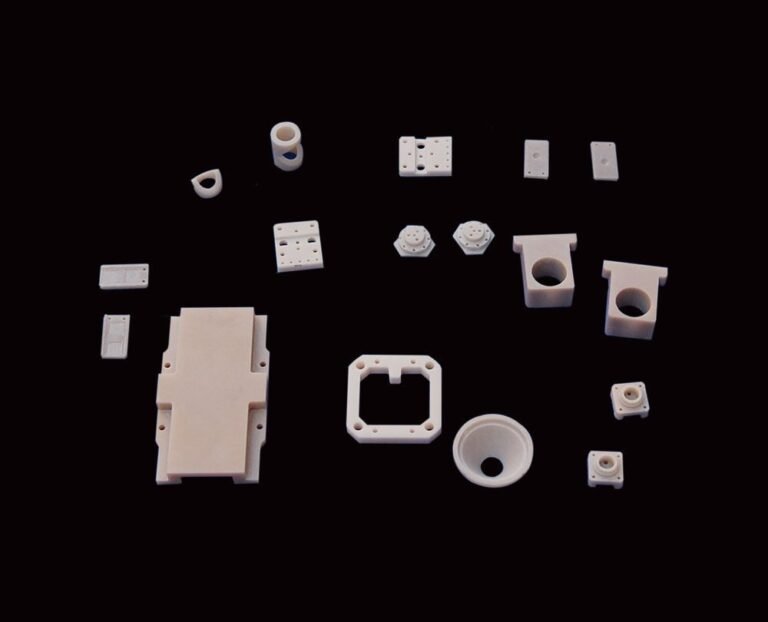
Custom ceramic manufacturing
Custom Aluminum Nitride Ceramic Parts Manufacturer
Precision AlN components manufactured to customer drawings and application requirements.
- Drawing-based customization
- Prototype to production
- Precision machining and inspection
What we manufacture
Custom Aluminum Nitride Components We Manufacture
Substrates, discs, fasteners, spacers and custom geometry, each produced to the drawing on the order rather than taken from stock.
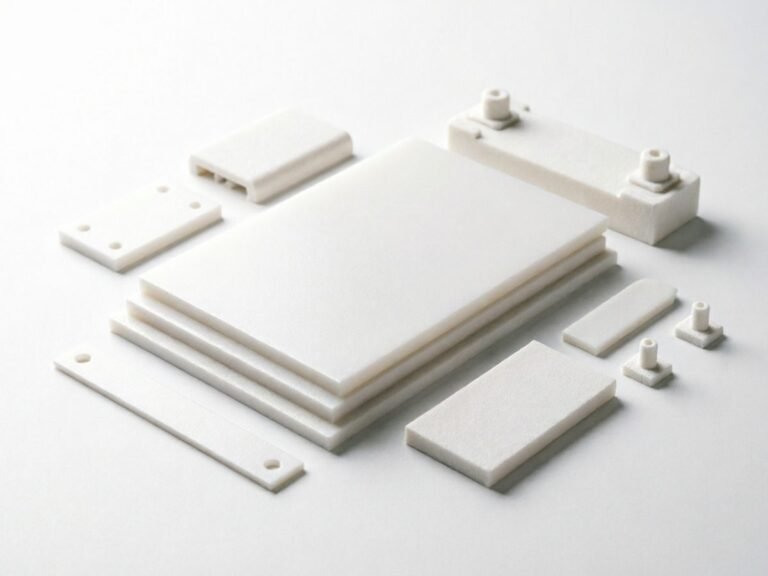
AlN Substrates & Plates
Flat elements carrying a thermal or electrical interface, machined to the drawing.
View details
Where a flat element carries the thermal or electrical interface it is specified as a substrate, because the interface requirement changes the process on the faces. State which face carries the requirement and how thick the part is: together they set the finish, the flatness callout and the handling plan.
- Flatness and parallelism set by the interface requirement
- Thickness measured across the part, not at one point
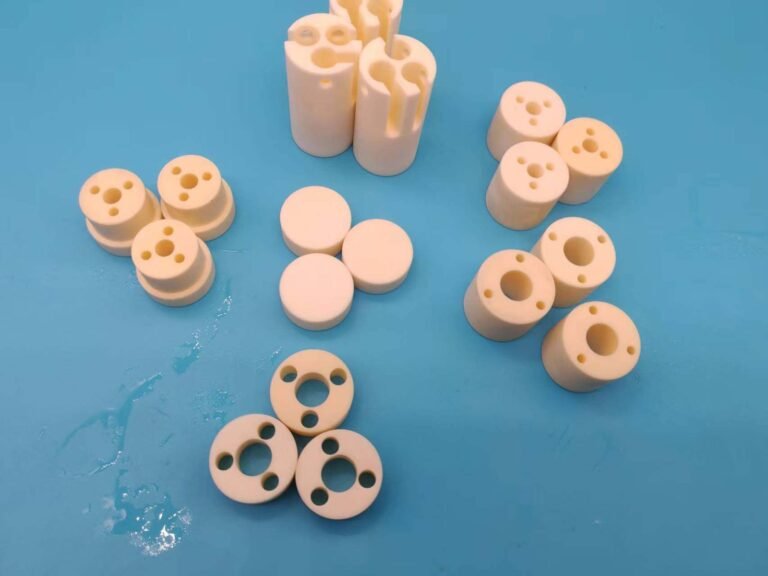
AlN Discs, Flanges & Cylindrical Parts
Discs, flanges and cylindrical thermal parts produced to the drawing.
View details
Cylindrical parts come through as tubes and sleeves; discs and flanges follow the same route, with the flat faces ground to the callout. Geometry and lead time are less of a constraint here than in silicon carbide, because this material grinds more readily.
- Bore and face geometry to the drawing
- Wear and thermal faces finished to suit the interface
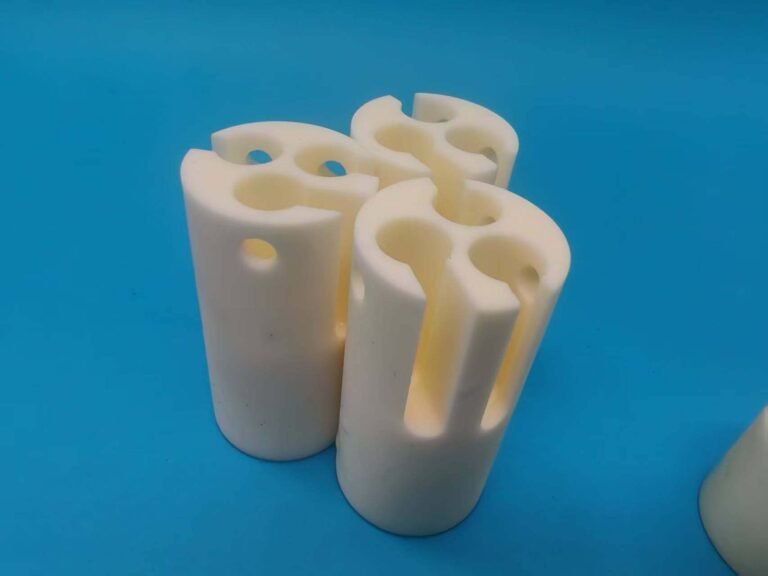
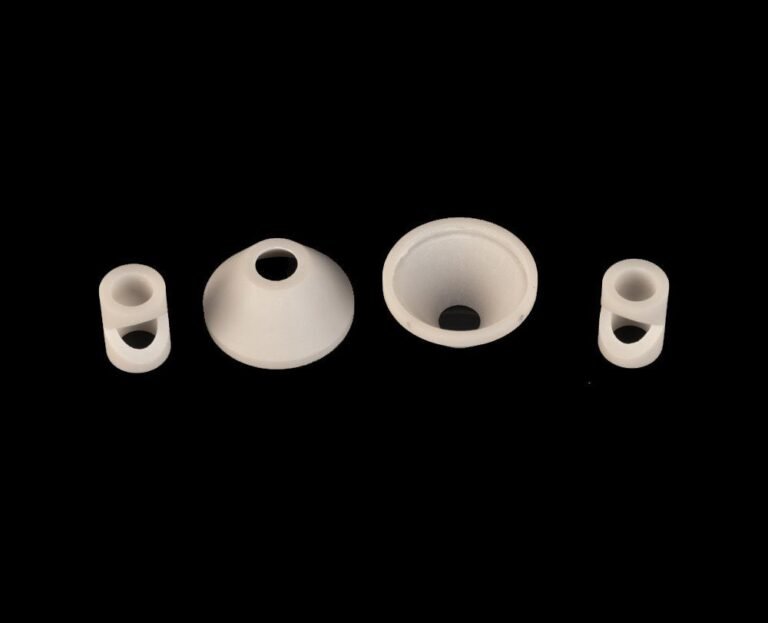
AlN Slotted Cylindrical Parts
Cylindrical parts with precision slots, bores and cross-holes.
View details
Slots, bores and cross-holes are machined to the drawing, with the wall thickness and datum scheme reviewed before quotation. Thin sections reach a handling limit before a grinding limit, so the support plan through the sequence is part of the quote.
- Slot and bore geometry to the drawing
- Very thin sections handled against a deflection limit
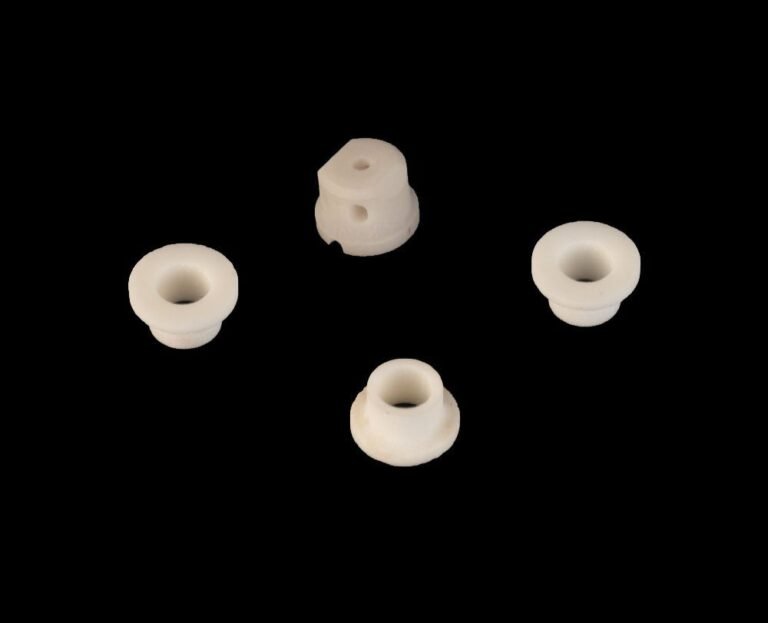
AlN Insulating Bushings & Spacers
Flanged bushings and spacers that insulate while carrying load.
View details
Thermal insulating spacers in semiconductor equipment and flanged insulators for powered assemblies are produced to the drawing. Surface cleanliness matters for both thermal and electrical performance, so the finishing process is controlled.
- Flange and bore geometry to the drawing
- Surface cleanliness controlled after grinding
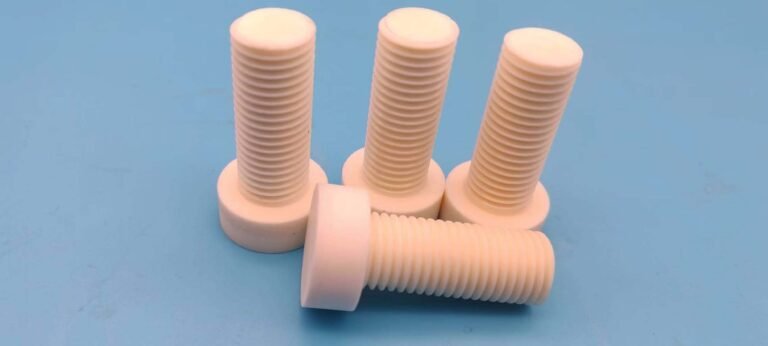
AlN Threaded Fasteners & Studs
Threaded ceramic studs and fasteners for insulated assemblies.
View details
Threaded ceramic fasteners insulate an assembly while holding it together. Thread form, shoulder geometry and the sealing face are produced to the drawing; surface cleanliness matters because residue affects both thermal and electrical performance.
- Thread and shoulder geometry to the drawing
- Finishing process controlled for surface cleanliness
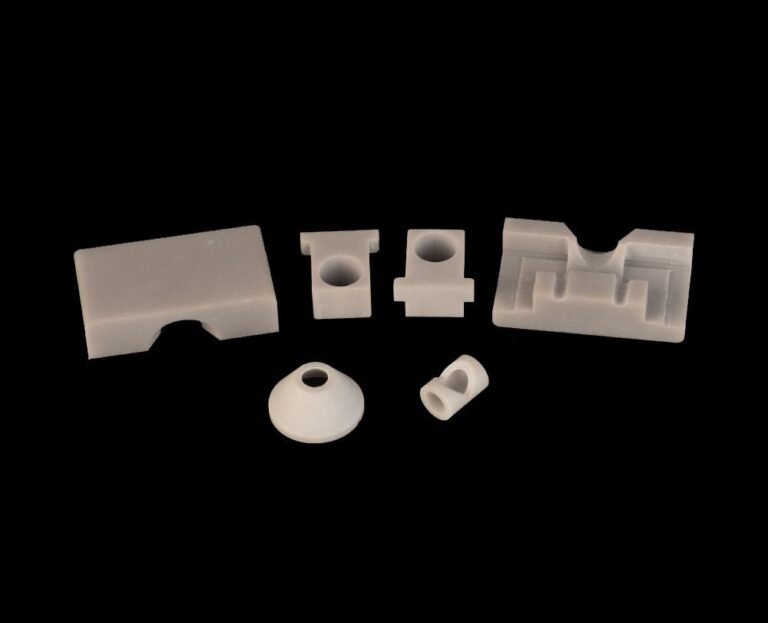
AlN Complex Machined Components
Custom complex geometry machined from the drawing, not from stock.
View details
RF and microwave mounting parts, power module baseplates and heat spreaders with integrated insulation are all produced to the drawing. Each request is produced to the drawing on the order rather than taken from stock.
- Feature-specific geometry review before quotation
- Material confirmed in writing against the supplied grade
Engineering problems we help solve
Engineering Challenges Addressed with Custom Aluminum Nitride
Each row links a published property to the benefit it buys.
View the engineering challenges table
| Property | Engineering benefit | Relevant application condition |
|---|---|---|
| Thermal conductivity about 170 W/m·K (representative grade) | Removes heat through the part | Dense power electronics |
| Volume resistivity 2.75×10<sup>14</sup> Ω·cm | Insulates electrically while conducting heat | Isolated thermal paths and substrates |
| CTE around 4.6×10<sup>-6</sup>/K | Lower stress in bonded assemblies than higher-expansion oxides | Metallised and brazed joints |
How it works
From Your Drawing to Finished Aluminum Nitride Components
You submit the drawing; the component is made and inspected to the agreed specification.
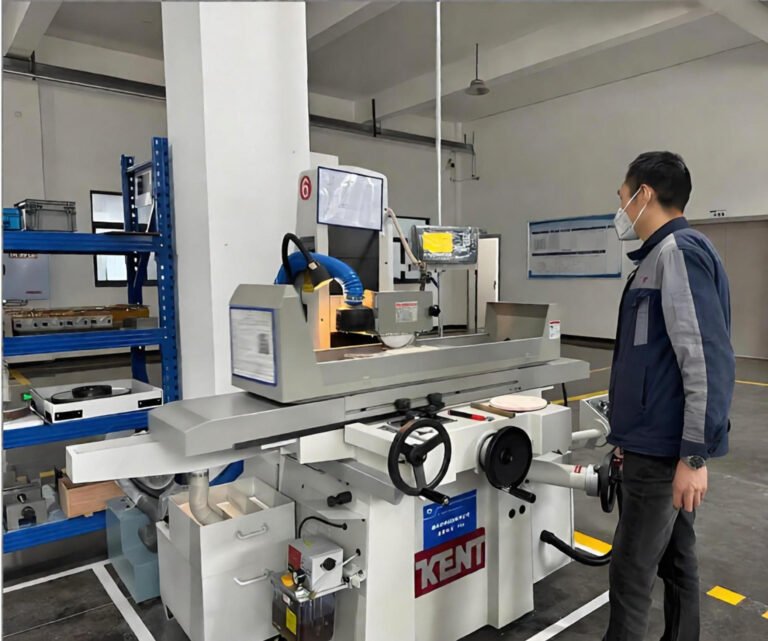
Precision Machining
Diamond grinding and CNC machining produce the geometry on your drawing; this material grinds more readily than silicon carbide, which shortens lead time.
View details
- Route chosen per geometry and tolerance: green machining, diamond grinding, lapping or polishing
- Thin, large-area parts supported against deflection
- Cleaning after grinding treated as part of the process
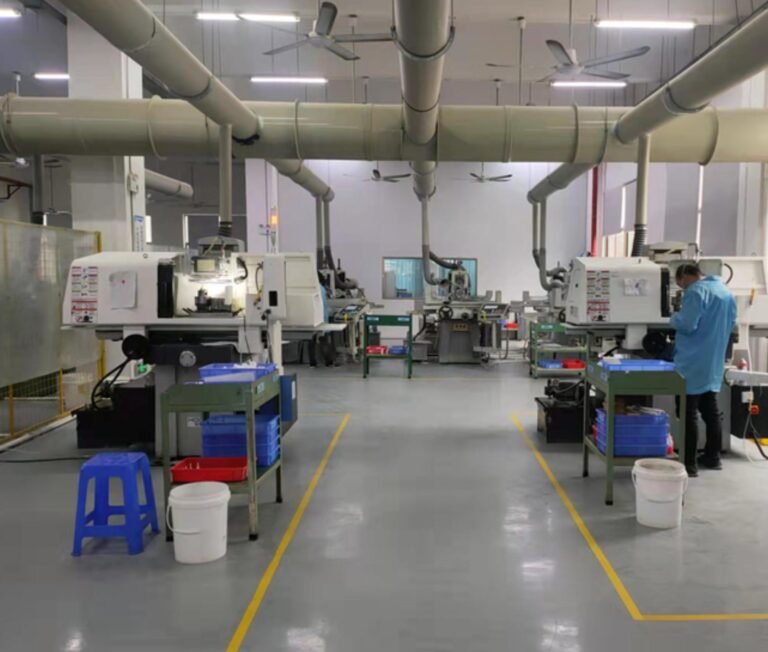
Grinding and Finishing
Faces are ground and finished to the callout on the thermal or bonding face, with surfaces away from the thermal path left as-ground.
View details
- Thickness and thickness uniformity measured across the part
- Flatness and parallelism set by the thermal interface requirement
- Surface roughness specified from the interface requirement
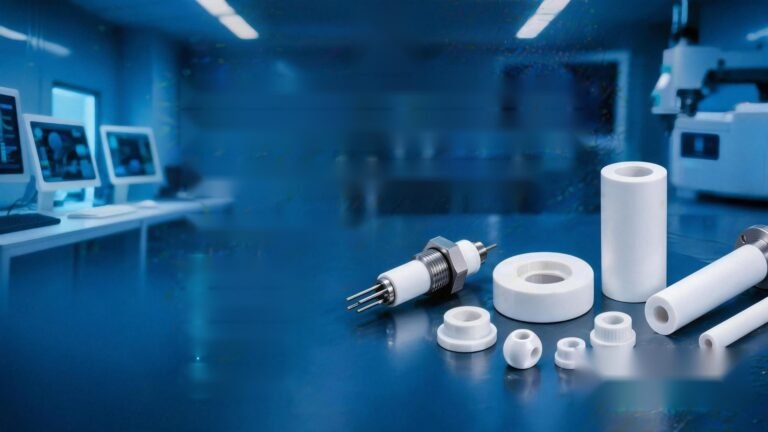
Inspection Against the Drawing
Flatness, parallelism, thickness uniformity and datum geometry are verified against the agreed requirements before shipment.
View details
- Flatness and parallelism of thermal faces measured, because contact resistance depends on conformity
- Thickness measured across the part to catch taper and bow
- Datum geometry and position measured on the CMM where the drawing carries callouts
Precision & inspection
Confirmed Manufacturing Capability References
Feature-specific capability references quoted in this material’s context, not blanket tolerances for every material or geometry.
Achievability depends on material, part size, wall thickness, feature geometry, datum scheme and finishing process. Final capability is confirmed during drawing review.
Engineering essentials
Aluminum Nitride Engineering Overview
Why engineers select it, and the limitations that follow.
Technical comparison
Aluminum Nitride against Alumina
Each bar is the range published for that material family, taken from the comparison table in the selection centre.
Thermal conduction with electrical insulation
A representative room-temperature value for standard commercial grades is about 170 W/m·K; the actual value varies with purity, oxygen content, additives, density, processing and temperature.
View technical details
- Specified where heat must be removed across a section that must not conduct electricity
- Published volume resistivity 2.75×10¹⁴ Ω·cm
- Where a property governs the design, state it on the drawing so it is confirmed against the supplied batch
Dimensional stability in bonded assemblies
Low thermal expansion relative to its conductivity limits stress in bonded assemblies, and flatness is held through the sequence.
View technical details
- Good dimensional stability, so flatness is held
- Thin, large-area parts handled against a deflection limit
- The material decision and the manufacturing route are one decision seen from two ends
What it is not good at
Not the hardest ceramic, so it is not the answer to an abrasion problem; cost is above alumina, justified only where the thermal path requires it.
View technical details
- Moisture sensitivity of the raw material demands controlled processing
- Surface cleanliness matters for both thermal and electrical performance
- Stating this up front prevents a material being selected for the one thing it cannot do
Where to go next
Related engineering pages for material selection and comparison.
What to expect on the drawing
Tolerance and finish are specified per feature. An overall callout on the whole part is the most common cause of an unnecessarily expensive quotation. Surface roughness is best specified from the interface requirement rather than by habit.
View the full drawing and tolerance guidanceQuestions
Frequently Asked Questions About Custom Aluminum Nitride Parts
Why not simply use a metal heat spreader?
Because it conducts electricity as well as heat. Aluminum nitride does both jobs in one part and removes an interface from the thermal stack.
How flat does an AlN substrate need to be?
Flat enough for the interface material in use. Contact resistance depends on conformity, so the requirement comes from your thermal design and should be stated.
Can aluminum nitride be machined into complex shapes?
Yes. It grinds more readily than silicon carbide, so geometry and lead time are less of a constraint.
Request a quote
Request a Quote for Custom AlN Ceramic Parts
Send the drawing, the material grade if it is fixed, the quantity, the critical dimensions and tolerances, the required surface finish and the operating environment. The material is confirmed in writing with the quotation.
Engineering reference
Engineering Reference Library
Complete material engineering detail, retained on this page. Open a group for the full reference.
Material Fundamentals & Selection
Material overview
What is aluminum nitride ceramic?
Aluminum nitride (AlN) is a compound of aluminium and nitrogen sintered into a technical ceramic whose distinguishing property is thermal conduction combined with electrical insulation. A representative room-temperature value for standard commercial grades is a thermal conductivity of about 170 W/m·K; the actual value varies with purity, oxygen content, additives, density, processing and temperature. Published volume resistivity is 2.75×10¹⁴ Ω·cm. It is specified where heat has to be removed across a section that must not conduct electricity: substrates, heat spreaders and insulated thermal paths.
When to choose Aluminum Nitride
Each row links a published property to the engineering benefit it buys and the condition where that benefit is the reason for the choice.
| Property | Engineering benefit | Relevant application condition |
|---|---|---|
| Thermal conductivity about 170 W/m·K (representative grade) | Removes heat through the part | Dense power electronics |
| Volume resistivity 2.75×10<sup>14</sup> Ω·cm | Insulates electrically while conducting heat | Isolated thermal paths and substrates |
| CTE around 4.6×10<sup>-6</sup>/K | Lower stress in bonded assemblies than higher-expansion oxides | Metallised and brazed joints |
If your project looks like one of these
- Power module substrates and heat spreaders
- Insulating components where heat must also be removed
- High-frequency and RF assemblies
- Sensor and detector mounting
- Thermal spacers in dense electronics
Substrates produced in this material are described in the ceramic substrates family. The equipment context is covered under semiconductor equipment, and the thermal design problem itself is set out in Ceramics for Thermal Management.
Why engineers select it
- Combines high thermal conductivity with electrical insulation, which very few materials do
- Removes an interface from the thermal stack compared with a metal spreader plus a separate insulator
- Good dimensional stability, so flatness is held
- Low thermal expansion relative to its conductivity, which limits stress in bonded assemblies
- Machines better than silicon carbide, which shortens lead time
Complete Aluminum Nitride Property Table
Representative published values for material selection. Where a property governs the design, state it on the drawing so it is confirmed against the supplied batch.
Material properties are representative and grade-dependent. Final material selection should be confirmed against the specific grade and application conditions. The inspection certificate for the batch supplied is the governing document for a delivered order.
| Property | Typical value |
|---|---|
| Colour | Grey-white |
| Density (g/cm³) | 3.3 |
| Flexural strength, 20 °C (MPa) | 470 |
| Compressive strength, 20 °C (MPa) | 2100 |
| Elastic modulus, 20 °C (GPa) | 320 |
| Fracture toughness, 20 °C (MPa√m) | 2.6 |
| Poisson’s ratio, 20 °C | 0.24 |
| Rockwell hardness HRA | 87 |
| Vickers hardness HV1 (kg/mm²) | 1122 |
| Rockwell hardness R45N | 78.5 |
| Thermal expansion coefficient (×10⁻⁶/K) | 4.6 |
| Thermal conductivity, 20 °C (W/m·K) | 170 |
| Thermal shock resistance (ΔT, °C) | 400 |
| Specific heat (J/g·K) | 0.72 |
| Maximum use temperature, in air (°C) | 1000 |
| Volume resistivity, 20 °C (Ω·cm) | 2.75×10¹⁴ |
| Dielectric strength (kV/mm) | 17 |
| Dielectric constant, 1 MHz, RT | 8.38 |
| Dielectric loss tan δ, 1 MHz, 20 °C | 3×10⁻³ |
Aluminum Nitride against Alumina
Aluminum Nitride against Alumina
Strength in bending and heat removal separate the range faster than any other pair of properties. Each bar is the range published for that material family, taken from the same comparison table that appears in the selection centre.
Flexural strength, MPa
- Alumina (Al2O3), 95-99.7%300 – 380
- Aluminum nitride (AlN)470
A longer bar carries more load before it breaks. A range covers the grades supplied in that family rather than one nominal figure.
Source: Flexural strength (MPa)
Thermal conductivity, W/m·K
- Alumina (Al2O3), 95-99.7%20 – 32
- Aluminum nitride (AlN)170
A longer bar moves heat away faster. Conducting heat while still insulating electrically is the pairing power electronics needs, and it is why this property is read next to strength.
Source: Thermal conductivity (W/m·K)
Material engineering reference: Aluminum Nitride (AlN) for Custom Precision Components
Applications & Alternative Ceramics
Aluminum Nitride in service
The sectors below are the ones that specify this material, with the component that carries the requirement and the material property that earns the place. Each entry opens the sector page for the full component list.
A sector that is not listed is not a sector that is refused. It means the material has not been the obvious answer there, and the review starts from the operating condition instead.
An insulating material is not chosen on resistivity alone. Where the same part also has to move heat, the decision usually sits between alumina and aluminum nitride, and that comparison is set out in how an insulating ceramic is selected, including why wall thickness on its own does not settle it. The parts that carry the requirement into an assembly – spacers, standoffs, washers and sleeves – are collected under electrical insulation.
What to compare it against
These are the alternatives that most often come up against Aluminum Nitride, with the reason each might be preferred.
What is produced in this material
What is produced in this material
Power electronics substrates
Heat spreaders with integrated insulation
Thermal insulating spacers in semiconductor equipment
RF and microwave mounting parts
Discs, flanges and cylindrical thermal parts
Electronic ceramic substrates and plates
Ultra-high-temperature sealing components
Power module baseplates and heat spreaders
AlN substrates
Plates, sheets, tubes and machined parts
Requests for aluminum nitride arrive in a few recurring shapes, and each one is produced to the drawing on the order rather than taken from stock. Flat elements come through as plates and blocks, where the flatness callout decides how the faces are ground and how the part is supported through the sequence. Cylindrical parts come through as tubes and sleeves. A flat element that carries the thermal or electrical interface is specified as a substrate instead, because the interface requirement changes the process on the faces.
Two points decide most aluminum nitride quotations: which face carries the thermal or electrical requirement, and how thick the part is. State both on the drawing even where the tolerance is open, because together they set the finish, the flatness callout and the handling plan. A quotation that has to assume them is priced for the assumption.
Manufacturing & Design Considerations
What the material costs in production
The material decision and the manufacturing route are the same decision seen from two ends. Green machining, diamond grinding, lapping and polishing each have a place, and the route depends on the geometry and the tolerance.
- Grinding is more forgiving than SiC, so lead times are shorter
- Surface finish on the thermal or bonding face is a functional callout
- Thin, large-area parts are handled carefully because flatness is lost the moment the part breaks or deflects
- Cleaning after grinding is part of the process, since residue affects the thermal interface
Threaded ceramic studs
AlN discs and flanges
What to expect on the drawing
Tolerance and finish are specified per feature. An overall callout on the whole part is the most common cause of an unnecessarily expensive quotation.
Tolerance considerations
- Thickness and thickness uniformity are the tolerances that matter, measured across the part rather than at one point
- Flatness and parallelism are set by the thermal interface requirement
- Very thin sections reach a handling limit before a grinding limit
Surface finish considerations
- The functional face is finished to suit the bonding or thermal interface process
- Surfaces away from the thermal path are left as-ground
- Surface roughness is best specified from the interface requirement rather than by habit
Inspection & Technical Documentation
How critical features are verified
On a thermal substrate, flatness, parallelism and thickness uniformity decide whether the part works in the stack.
- Flatness and parallelism of thermal faces are measured, because contact resistance depends on conformity
- Thickness is measured across the part, not at a single point, to catch taper and bow
- Surface finish on the thermal or bonding face is verified against the interface requirement
- Datum geometry and position are measured on the CMM where the drawing carries callouts
The equipment behind these methods is listed on the inspection and metrology page.
Technical documents
No file on this page is offered as a download, because each document is generated against the grade and the drawing on the order. What can be issued, and when, is listed here instead.
| Document | Applies to | Format | Issued |
|---|---|---|---|
| Material grade certificate | The grade the part is produced from | With the shipment | |
| Dimensional inspection record | The dimensions called out on the drawing | With the shipment | |
| Certificate of conformity | The finished part, against the drawing | With the shipment | |
| First article inspection report | The first part produced to a new drawing | On request; method agreed at quotation | |
| Material property data for the selected grade | The grade in question | On request, or from the material manufacturer |
A document that is not on this list is not refused by default; it is quoted once the method behind it has been confirmed. State what your incoming inspection will check, and the document set is agreed before the order is placed.