Engineering guide
Silicon Carbide vs Silicon Nitride for Structural Components
Two structural ceramics with different failure modes. Silicon carbide is harder and more thermally capable; silicon nitride is tougher and survives load. The choice is usually decided by which one fails first.
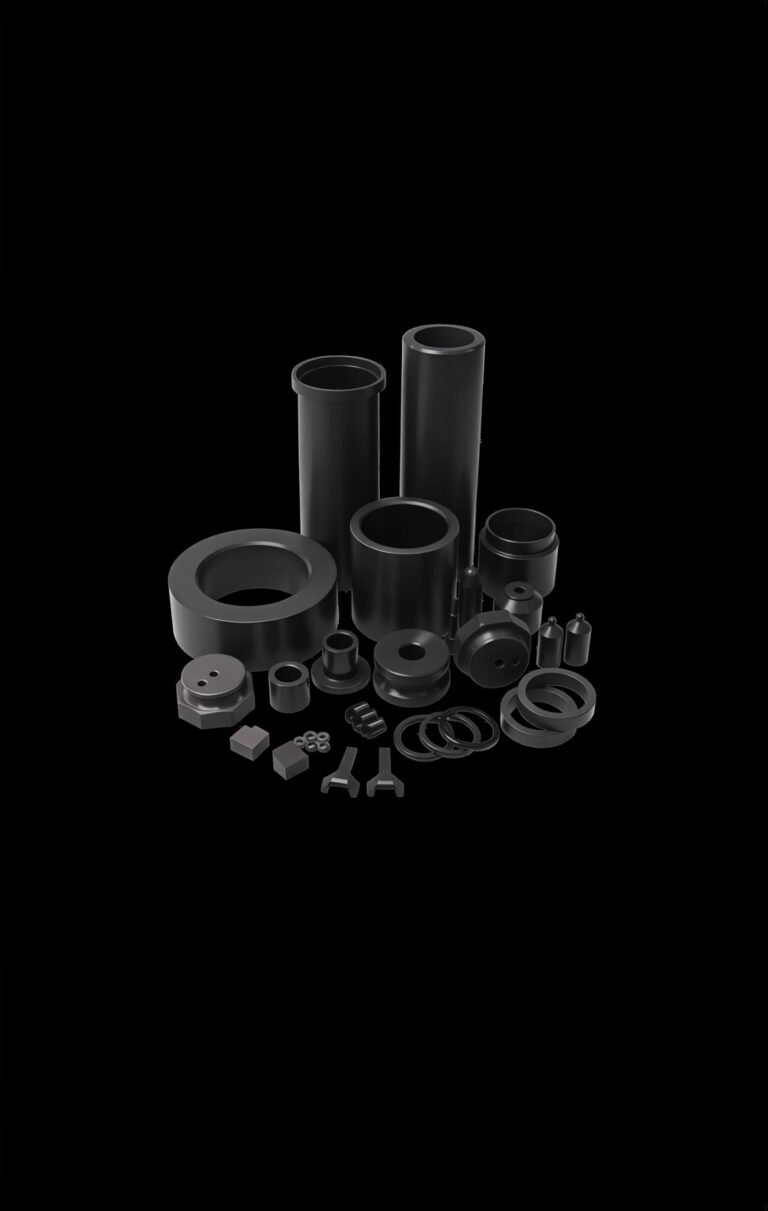
Comparison
Where the two diverge
| Property | Silicon carbide (SiC) | Silicon nitride (Si3N4) |
|---|---|---|
| Hardness | Highest of the range | High |
| Fracture toughness | Medium; brittle | High; tolerates load and impact |
| Thermal shock | Excellent | Excellent |
| Thermal conductivity | High | Medium |
| Electrical | Often conductive | Insulating |
| Abrasion resistance | Best in the range | Good |
| Relative grinding cost | Highest | High but lower than SiC |
Vickers hardness, kg/mm2
- Silicon carbide (SiC)2100
- Silicon nitride (Si3N4)>1550
Hardness is where silicon carbide leads, and it is also why it costs more to grind. The harder material removes the tool faster, so the same geometry takes longer in silicon carbide than in silicon nitride.
Source: Vickers hardness (kg/mm²)
The property sets behind each column of the table above, and the grades each material is supplied in, are on the silicon carbide and silicon nitride material pages.
How each one fails
Choosing between them is choosing which failure mode you can tolerate.
| Service condition | Behaviour |
|---|---|
| High-velocity abrasion | SiC outperforms; Si3N4 wears faster |
| Impact or shock | Si3N4 survives; SiC cracks |
| Cyclic load | Si3N4 has the fatigue behaviour required; SiC does not |
| Rapid thermal cycling | Both perform well; SiC has the higher ceiling |
| Electrical isolation required | Si3N4 only, since SiC is often conductive |
Where the money goes
Both are expensive to grind. Silicon carbide is the slower of the two, which is why a loose tolerance matters more here than in any other material.
- Grinding time dominates the price in both materials
- Silicon carbide tool wear is rapid, which is reflected in cost
- Complex geometry multiplies cost faster in SiC than in Si3N4
- A loose general tolerance class is the single largest saving available in either material
A practical shortlist method
Answer these in order and the choice usually makes itself.
The part and the process
Frequently asked
Which is better for a wear part?
Silicon carbide, if the wear is abrasive and there is no impact. Silicon nitride where the same part also carries load.
Can silicon carbide be used for an insulator?
Often not, because many grades are electrically conductive. If the part must insulate, that requirement should be stated at the start because it changes the material.
Why is silicon carbide so expensive to machine?
Because of its hardness. Removal rates are low and diamond tool wear is rapid, so the cost is dominated by grinding time rather than by the material price.
Which one handles thermal shock better?
Both are good. Silicon carbide has the higher ceiling, but silicon nitride is preferred where thermal cycling combines with mechanical load.
Have a drawing that this guide applies to?
Send it with the material and the quantities. The review confirms what is achievable before any price is issued.